
Children were meant to play and importantly, play is more than just fun for young children. Play is essential in fostering healthy development and stokes the growth of a child’s cognitive, social, and emotional skills. The National Association for the Education of Young Children would state that play and learning are not separate activities. They are intertwined.

Mildred Parten was one of the first sociologists to extensively study the play of children. Through her studies she found that as children grow, their play evolves through different stages and that each serves a crucial role in a little one’s overall learning process. These essential stages would form what she coined as the Six Stages of Play and are foundational in a child’s early childhood education.
You can see the stages of play firsthand by coming out for a tour here at Clover Hill Children’s Center. Schedule a tour and visit our classes to see play in action!
The Six Stages of Play
Stage 1: Unoccupied Play (Birth to 3 Months)
Exploration is key at this early stage. The world is brand new for a baby of this age and everything is part of discovery. They make seemingly random movements, engage with their own hands and feet, and observe their surroundings, taking in every sight, sound color, and more. While it may not look like traditional play from the outside, these early interactions can teach simple basics about how the world works. This is key in setting a little one up for future cognition, motor and sensory skills development. (Source) For a child of this age, this stage might look like:
- Kicking, wiggling, and moving their arms and legs
- Staring at objects, people, or ceiling fans
- Experimenting with their own voice (cooing and gurgling)
We offer an exceptional environment for growth at this stage of life. Schedule a tour today to peek at the learning happening constantly within our infant rooms. 
Stage 2: Solitary Play (0-2 Years)
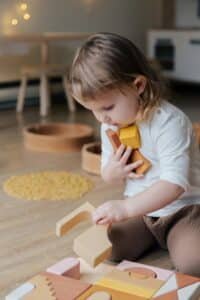
During the stage of solitary play, children play alone with little interest in what others are doing. Infants and toddlers interact with their toys independently and are learning through exploration and repetition. While it is hard to imagine that solitary play is important, Bright Horizons asserts that this stage plays a major role in helping children hone concentration skills and can also encourage self-sufficiency and creativity.
What it looks like:
- A toddler stacking blocks independently
- A baby shaking a rattle
- A child flipping through a book on their own
We have a plethora of play choices to meet any child’s growing interests. Come for a tour and see what fun we have ready here at Clover Hill Children’s Center!
Stage 3: Onlooker Play (2+ Years)
As little ones move into the toddler stage they become ever-watchful observers—this can seem similar to the first stage, but with different observations. Children might choose to watch play happening rather than participate and while this might be off-putting, do not be dismayed! They may simply not be ready to join in. Children at this stage are soaking in all they see and may begin to have tons of questions or might start to implement the new play techniques they’ve witnessed. This not only gives them new context for play but also introduces and fosters social awareness.
 What It Looks Like:
- A toddler watching older kids build a sandcastle
- A child standing nearby while others play tag
- A preschooler listening to a group’s conversation without contributing
We are big proponents of learning and meeting each child where they are at here at Clover Hill Children’s Center. While we have an array of different types of toys, we also have wonderful early childhood educators that are ready to help your child learn and grow. Give us a call to pop by and see what we are all about!
Stage 4: Parallel Play (2-3 Years)
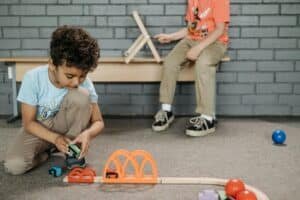
Parallel play is when children play alongside each other without interacting. The children could be playing with the same toys in similar ways, but they do not always play with each other just yet. This is completely developmentally appropriate and helps kids build confidence in sharing spaces as well as enforces social confidence. While it may feel disheartening to bring your toddler to a play date with another toddler and neither plays with the other, they are still playing, learning, and building relationships!
What this looks like:
- Two toddlers playing in a pretend kitchen though neither is part of the others process or ‘cooking’
- Children doing arts and crafts together side by side, but working on their own project
- Playing with toy cars without engaging in a shared story
We are ready for some side-by-side play here at Clover Hill! Come check out our classrooms to see what we have planned to help grow your child’s play skills!
Stage 5: Associative Play (3-4 Years)
At this stage, children are more able to take turns and practice cooperation. They begin to interact with each other, but their play isn’t fully structured—they will share toys and ideas, but there’s no set goal or rules. This play is essential in the stair steps of their development and also builds on their language and communication skills.
What it looks like:
- A group of kids playing with toy animals, occasionally swapping them
- Children making separate castles with blocks, sharing pieces and space
- Drawing together, sharing crayons but working on individual pictures
Our Early Childhood educators and caregivers here at Clover Hill are wonderful and excellent facilitators of play. Schedule a tour today to see them in action!
Stage 6: Cooperative Play (4+ Years)
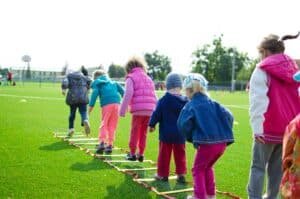
In this final stage, children are able to engage in a more structured play with rules and roles. They work together toward a common goal such as building a castle of Magna-tiles, playing house, or working on an art project together. They are working on their teamwork, problem solving skills, as well as their social and emotional maturity. An article from Healthline.com observes that playing cooperatively often creates bountiful opportunities for little ones to practice their budding conflict resolution skills–an essential life skill for everyone! With this overall maturity and growth brings an ability to foster deeper play and deeper friendships.
What It Looks Like:
- Playing a game of freeze tag
- Building a puzzle with others
- Playing ‘veterinarian’ with friends and stuffed animals–where those involved have roles and a story to play
Come see the different stages in action with a tour! Contact us to schedule that today!
The Big Impact
Play is the foundation of learning for children, not simply a past time. Whether you are an early childhood educator, parent, caregiver, daycare worker, or grandma watching the kiddos while mom runs to an appointment, understanding this truth has a lasting impact. By having a familiarity with these six stages of play children can be understood on a developmental level. This gives each little one’s caregivers the opportunity to hold realistic expectations of them but also build on that foundation to encourage them in the next stage.
Here at Clover Hill Children’s Center, we know about the importance of play and are ready to meet each child at whatever stage they are at. From toys to crafts, rattles to books, pretend play stations or outdoor areas ready for a game of tag, we have a plethora of opportunities for diverse and engaging play for everyone! Schedule a tour today; we would love to show you around!