
 How Can I Help My Child Calm Down?
Calming down, and doing so well, is not an innate human ability but rather a skill that needs practicing and honing. For preschool-aged children, they are merely at the beginning of a lifelong journey to sharpen such a skill. Whether they are having a meltdown over the fact that you broke the banana in half or succumbing to a tidal wave of emotions at daycare drop-off, they (and parents, teachers, and caregivers under the same situation) are constantly faced with the opportunity to practice self-regulating their emotions. This is key within early childhood education and practicing healthy emotional regulation habits from the beginning helps to lay a healthy foundation to build on as a child grows.
The big question is, how can parents, early childhood educators, caregivers, aunts, uncles, etc. help support children in through this learning process? It’s not as difficult and nuanced as you might initially think! So, let’s dive into some practical and research-backed strategies that can help children grow and practice their emotional regulation as they learn to calm down well.
Here at Clover Hill Children’s Center we see big emotions on a daily basis–as is the nature of working with a lot of little learners! We are happy to patiently partner with children as well as families as a whole to help institute healthy calm-down practices and to further the growth of every child’s emotional regulation. Come for a tour and let’s chat about how we can come alongside your family in your child’s early childhood education.
1. Name It to Tame It
 Dr. Dan Siegel, a neuropsychiatrist and author of The Whole-Brain Child, coined the phrase “name it to tame it,” referring to the power of labeling emotions to help manage them. Helping preschoolers name their feelings (“You’re feeling really frustrated right now”) when they are overcome by emotion not only engages the rational part of the brain to help start the calming process, but it also shows them that they are heard. This can give them an anchor while they feel adrift on the sea of emotion.
Naming emotions also broadens a child’s emotional vocabulary that they can better express their feelings–which is an essential skill to possess not just in calming down, but in expressing to others how you’re feeling for help or healthy communication purposes.
Learning to pinpoint and describe your feelings is a large part of early childhood education. Schedule a tour today and see how we help our children learn and grow in this area here at Clover Hill.
2. Model Calm Behavior
Children mirror the behaviors they see around them–specifically those from the adults in their lives. emotionally charges moments are often the times when the behavior they’ve seen modeled for them comes out, showing the importance of choosing your own responses and reactions wisely. According to research from the Child Mind Institute, parents who respond with calm, measured reactions, are more likely to see their children mirror that emotional regulation over time. So, take a deep breath before you respond, you might not realize who is paying attention.
Implementing calm-down techniques such as simple breathing exercises, guided energy, and body movements can be a monumental aid. You can even implement a ‘calm-down corner’ within your home or classroom. Stock the ‘calm-down corner’ with sensory items like stress balls, stuffies, calming books and music.
Two excellent tools: Sesame Street’s Belly Breathe with Elmo or Big Life Journal Calm Down Dorner Cards for Kids

3. Stick to a Predictable Routine
Routine is an unpraised superpower within early childhood education–not just within daycare and preschools, but for home, as well! Experts from the website Zero to Three supports this: When children know what is coming next and what to expect it gives them a sense of security and helps them feel more in control. Predictability reduces uncertainty, which also reduces anxiety. This can make a huge difference in transitions–bedtime battles and morning rushes definitely come to mind here. Implementing a simple schedule that children can count on and even going the extra mile to offer a visual aid (such as a chart or a schedule with pictures) can make a huge difference in bolstering a preschooler’s confidence and reducing emotional outbursts.
We are all about routines here at Clover Hill Children’s Center. Call today to set up a tour and see the schedules we have for our various age groups!
 4. Offer Choices When Possible
Offering choices to a preschool-aged child does not mean putting them in the driver’s seat of their day and letting them make all the decisions. Rather, giving children options and choices in a guided way can help develop their autonomy as they grow and want to express themselves. Allowing them to participate in simple choices that reach the end goal you as the adult have set allows them to be a part of their day, express themselves, and can help prevent power struggles and feel calm. “Do you want the red shirt or the blue shirt?” or “would you like to brush your teeth or your hair first” are simple enough to allow children a say while also reaching the needed end goal. An article from Parents.com supports that giving children the opportunity to make choices bolsters their independence and feelings that their opinions matter.
Schedule a tour here at Clover Hill Children’s Center, we would love to show you around and share our own tactics for fostering growth for each preschooler as a whole–emotionally, physically, intellectually, and more!
5. Use Books and Stories to Explore Emotions
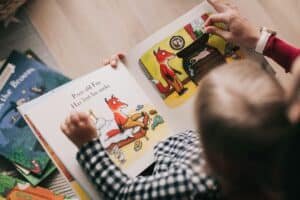
Stories supply children with a safe, imaginative spaces to process big feelings. Books like The Color Monster or When Sophie Gets Angry—Really, Really Angry… can be an excellent tool in sparking vibrant conversations about emotional management. Shows and movies such as “Daniel Tiger’s neighborhood” can also provide excellent opportunities as well as tactics to help little ones understand and respond to their big feelings.
Come visit us here at Clover Hill and chat with our teachers about the strategies and books they utilize in helping their students learn to manage their emotions.
Calm is a marathon, not a sprint
Helping a child learn to calm down well and manage their emotional responses is a long game of consistency, modeling, and patience. While some phases might feel like years instead of days or weeks, every moment invested in encouraging and teaching adds another brick to the foundation of a child’s emotional intelligence. Your relationship will grow stronger, as well, and will provide the opportunity to continue to support them as they grow. It might mean stepping back from a situation for a moment, taking some deep breathes or potentially another cup of coffee, but you will be supplying your preschooler with the emotional tools they need to be an emotionally intelligent and self-regulated adult.
We would love to join you on the learning marathon for your child’s early childhood education. Call today and let’s chat about how we can set your child off to a great start here at Clover Hill Children’s Center!